
You have no items in your shopping cart.
A cock ring restricts blood leaving the penis. Standard guidance is to wear one for no more than 20 to 30 minutes, never while asleep, and to remove it immediately if you notice numbness, coldness or colour change. Stretchy silicone is the safer material because it can be cut off in an emergency. Metal cannot.
Key takeaways
- 30 minutes is the working limit. Medical case reports describe genital incarceration when constriction devices are left on beyond roughly half an hour.
- Material is a safety decision, not a style one. Almost every strangulation case in the urological literature involves a rigid metal ring.
- Silicone can be cut off with scissors. Metal rings have required ring cutters, bolt cutters, orthopaedic saws and angle grinders in documented hospital cases.
- Never fall asleep wearing one. You lose the feedback that would tell you to remove it, and that is how short-term use becomes an emergency.
- Size for snug, not tight. It should hold position without indenting skin. If you cannot slide a fingertip underneath, it is too small.
- Numbness, coldness, darkening colour or pain mean remove it now — not in a few minutes.
- If it will not come off, go to an emergency department. This is a recognised urological emergency and delay is what causes lasting damage.
What's on this page
- How does a cock ring actually work?
- How long is it safe to wear one?
- Why does material matter more than style?
- How do you get the size right?
- Which type suits which situation?
- What we can't confirm
- When should you seek emergency care?
- Common myths
- FAQ
- Sources
How does a cock ring actually work?
The mechanism is simple and entirely mechanical. Blood enters the penis through arteries that sit deep and are relatively hard to compress. It leaves through veins that sit closer to the surface. A ring placed at the base compresses the shallow veins more than the deep arteries, so blood enters more easily than it leaves.
That is the whole principle. Everything else — vibration, nubs, double straps, ball-splitting designs — is about sensation and fit, not about the underlying mechanism.
The same principle explains the risk. A device designed to restrict outflow will keep restricting outflow for exactly as long as it is on, whether or not you are still paying attention.
Practical rule: set a timer before you put one on. The single most common factor in the injury case reports is losing track of time, not choosing the wrong product.
How long is it safe to wear one?
The widely used figure is 20 to 30 minutes, and it is not arbitrary. Clinical reviews of penile constriction devices describe genital incarceration developing when a ring is left in place beyond roughly thirty minutes, with the severity of injury tracking closely with how long circulation was restricted.
A review of treatment options and outcomes for penile constriction devices makes the central point plainly: early removal limits ischaemia time, and ischaemia time is what determines whether there is lasting damage to erectile and urinary function.
Two rules follow from that, and they matter more than any product choice:
- Never sleep in one. Sleep removes the feedback loop entirely. Several published cases involve a device worn overnight.
- Never wear one while intoxicated. Same reason — the warning signs are exactly the ones alcohol and drugs blunt.
Practical rule: if you have worn it for 30 minutes, take it off and wait before putting it back on. Resetting the clock is free. Ischaemia is not.
Dr Rena Malik, a board-certified urologist, covers the same ground in the video below and arrives at the same 30-minute ceiling independently. We have no affiliation with her and receive nothing from linking it — it is here because a clinician saying it carries more weight than a retailer saying it.
Why does material matter more than style?
This is the part most buying guides skip, and it is the most useful thing on this page.
Read the urological case literature on penile strangulation and a pattern is immediately obvious: the emergencies overwhelmingly involve rigid metal rings. A review of penile and scrotal strangulation due to metal rings and a study of four metallic-ring strangulation injuries describe the same sequence repeatedly: swelling increases, the ring cannot be removed, and the patient arrives at hospital needing industrial tools.
The removal methods named in those reports are not medical instruments. They include ring cutters, bolt cutters, orthopaedic oscillating saws and angle grinders — used on a swollen, compromised limb, under time pressure.
Silicone and rubber
Stretchy silicone fails safe. If swelling increases, the material gives. If it needs to come off immediately, a pair of scissors will do it — at home, in seconds, without an emergency department.
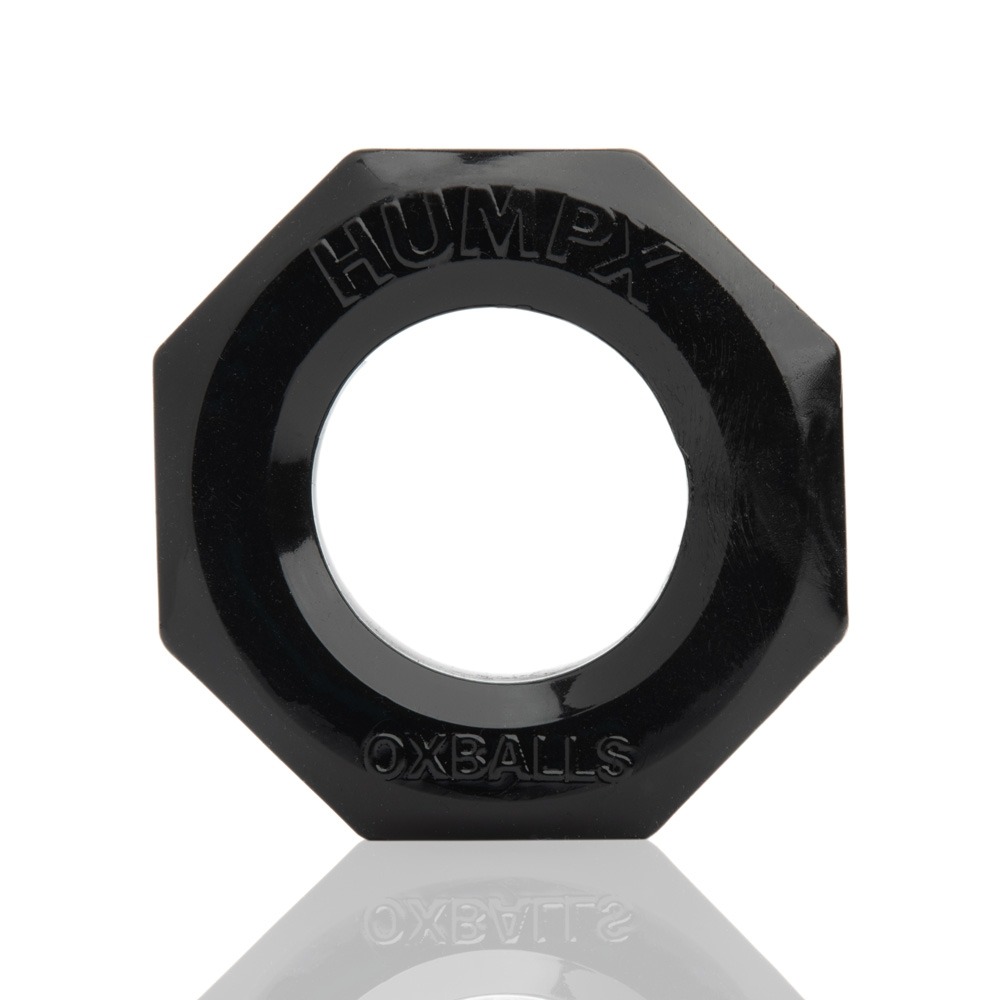
That single property is why we recommend silicone for anyone who is not already experienced. Options we stock include the Oxballs Humpx Extra Large at $13.50, the Oxballs Jelly Bean at $15.00, the lugged-texture Oxballs Cock Lug at $25.00, and the Blush Performance VS8 Silicone Double Ring at $26.00 for a cock-and-ball configuration.
Metal and steel
Metal rings are rigid, non-stretch and cannot be cut with anything you own. They hold a precise size, which some people prefer, and they conduct temperature, which some people enjoy. Those are real attractions and we are not going to pretend otherwise.
But the trade-off is absolute: if swelling outpaces the ring, there is no home remedy. Every published emergency removal we found involved metal. We stock metal rings and will continue to, but we are not going to recommend one to a first-time buyer, and we have not linked them here for the same reason we would not link a numbing lubricant in a caution about numbing lubricants.
Buying rule: if this is your first ring, buy stretchy silicone in a multi-size pack. Sizing is a guess until you have tried one, and a guess with metal is a bad bet.
How do you get the size right?
Sizing is where most discomfort originates, and it is easy to get approximately right.
- Measure the circumference at the base — around the shaft and behind the testicles if you want a cock-and-ball style — while erect.
- Divide by 3.14 to get the diameter.
- Choose a ring roughly 5 to 10% smaller than that diameter for stretchy silicone, which is designed to sit under mild tension.
Common internal diameters run from about 1.25 inches to 2 inches. Most people land between 1.5 and 1.75 inches, but "most people" is not a measurement.
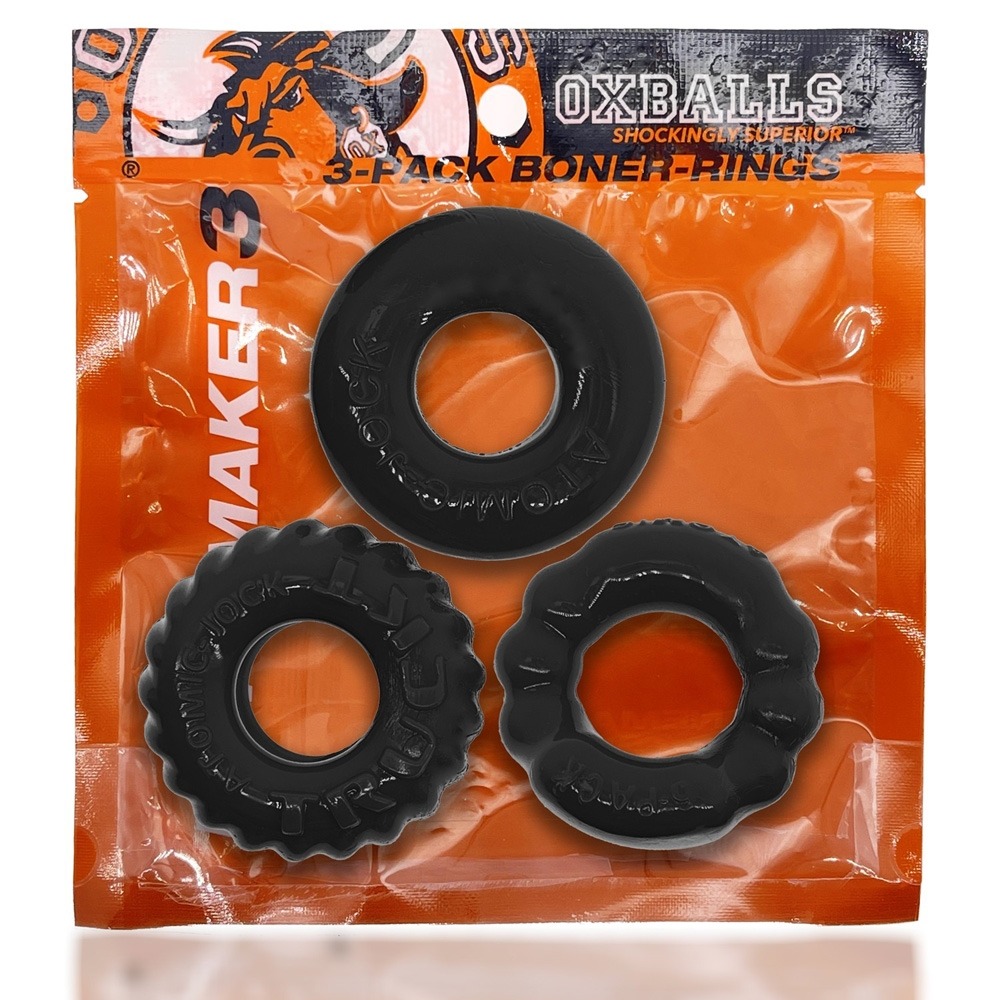
The practical shortcut is a multi-size kit. The Oxballs Bonemaker 3-Pack at $19.99 gives three stretchy sizes so you can find yours without committing, and the Oxballs Willy Rings 3-Pack at $14.00 is the cheapest way to test fit.
Fit test: you should be able to slip a fingertip between the ring and your skin. If you cannot, it is too small. If it slides out of position, it is too large.
Put it on before full erection — stretchy rings go on far more easily soft — and use a little water-based lubricant to help it seat.
Which type suits which situation?
| Stretchy silicone | Firm silicone | Metal / steel | |
|---|---|---|---|
| Removable in an emergency | Yes — cuts with scissors | Usually | No |
| Forgiving on sizing | Very | Somewhat | Not at all |
| Suitable for a first ring | Yes | Sometimes | No |
| Holds precise pressure | Less | More | Most |
| Safe to sleep in | No | No | No |
| Typical price here | $13.50–$20 | $25–$26 | Varies |
Nothing in the right-hand column is safe to sleep in. That row is the same for every material, and it is the one people get wrong.
What we can't confirm
- We have not tested wear-time limits ourselves. The 20–30 minute figure comes from published clinical guidance and case reviews, not from our own measurement.
- Individual tolerance varies. Circulation, sensitivity and anatomy differ. The guidance here is a ceiling, not a target to work up to.
- We do not publish internal diameters for every ring. Where a manufacturer does not state a measurement, we will not estimate one. Ask us before ordering and we will check with the supplier.
- Case-report literature is not incidence data. It tells you what goes wrong and how, not how often. We are not claiming rings are commonly dangerous — only that when they do go wrong, material determines how bad it gets.
When should you seek emergency care?
Remove the ring immediately if you notice numbness, tingling, coldness, or the skin turning pale, blue, grey or dark.
Go to an emergency department now if:
- The ring will not come off and swelling is increasing
- Pain is severe or getting worse
- The skin has changed colour and does not recover within minutes of removal
- You cannot urinate
- Sensation has not returned after the ring is off
Do not wait to see whether it settles. Published cases are consistent that delay is the variable that turns a recoverable episode into permanent damage, up to and including tissue death. Emergency staff deal with this and will not be surprised or judgemental — case reports exist precisely because it happens often enough to be documented.
Separately: recurring difficulty getting or keeping an erection is a clinical question, not a shopping one. If you are reaching for a ring to compensate for a change you have noticed, speak to a healthcare provider.
Common myths
"You can leave it on as long as it feels fine." Feeling fine is not evidence of adequate circulation. Numbness — the thing that makes it feel fine — is itself a warning sign.
"Metal is better quality." Metal is more precise and more durable. Neither is the same as safer, and precision is a liability when tissue swells.
"A tighter ring works better." A ring tight enough to restrict arterial inflow works against itself and raises the risk substantially. Snug, not tight.
"Vibrating rings are a different category." The ring component behaves identically. Every time limit on this page applies.
"If it gets stuck you can just cut it off." True for silicone. Not true for metal, which is the entire argument of this article.
Frequently asked questions
How long can you safely wear a cock ring?
Standard guidance is 20 to 30 minutes maximum. Clinical reviews describe genital incarceration developing beyond roughly half an hour, with injury severity tracking how long circulation was restricted.
Can you sleep with a cock ring on?
No. Sleep removes the feedback that would tell you something is wrong, and several published injury cases involve devices worn overnight.
Is silicone or metal safer?
Silicone. It stretches as swelling develops and can be cut off with scissors. Metal cannot be removed at home and dominates the emergency case literature.
What size cock ring should I buy?
Measure the base circumference while erect, divide by 3.14 for diameter, then choose roughly 5–10% smaller for stretchy silicone. A multi-size kit avoids guessing.
What are the warning signs to remove it?
Numbness, tingling, coldness, or skin turning pale, blue, grey or dark. Remove immediately rather than waiting.
What should I do if it is stuck?
If swelling is increasing or you cannot remove it, go to an emergency department straight away. Delay is what causes lasting damage.
Do cock rings need lubricant?
A little water-based lubricant helps a stretchy ring seat comfortably. Avoid silicone lubricant with silicone rings, which degrades the surface.
Sources and further reading
- Treatment Options and Outcomes of Penile Constriction Devices
- Penile and Scrotal Strangulation due to Metal Rings: Case Reports and a Review of the Literature
- Penile strangulation injury by metallic ring: a study of 4 cases
- Patient With Penile and Scrotal Strangulation Due to Prolonged Use of a Metal Ring Device
- Severe Penile Ischemia After Metallic Ring Strangulation
Related reading: our lube guide covers why silicone lubricant and silicone rings are a poor combination. Browse the full cock rings category for current stock.
About this guide
Written by the Gear Isle product team, West Sacramento, CA. Product specifications and prices were verified against our catalogue on 14 August 2026 and are subject to change.
This article is for general information and is not medical advice. Wear-time guidance is drawn from published clinical literature and is a ceiling, not a recommendation to work towards. Consult a healthcare provider about pain, numbness, colour change or any persistent symptom, and seek emergency care if a device cannot be removed.


