Monthly Archives: August 2026
-
Massage Glide vs Oil: Water, Silicone and Oil Compared
Choose by what else is involved, not by feel. Oil-based products weaken latex condoms. Silicone-based glides damage silicone toys. Water-based is the only option compatible with both, though it absorbs fastest and needs reapplying during a long massage.
Key takeaways
- Compatibility decides this, not texture. Every base feels good. Only one of them works with both condoms and silicone toys.
- Oil weakens latex. If a latex condom is anywhere in the evening, oil is out.
- Silicone glide ruins silicone toys — the same polymer clash covered in our lube guide.
- Water-based is the safe default. It absorbs fastest, which is the trade-off.
- Check oil blends for allergens. One product we stock contains peanut and lanolin oils. That matters more than any performance claim on the label.
- Essential oils are not massage oils. They need diluting into a carrier at roughly 2–5% before they touch skin.
- Massage products are not lubricants unless the label says so. Different testing, different intended use.
What's on this page
- The short answer
- At a glance
- Who should choose water-based?
- Who should choose silicone-based?
- Who should choose an oil?
- What about essential oils?
- Where they are identical
- What we can't confirm
- When should you speak to a clinician?
- Common myths
- FAQ
- Sources
The short answer
Water-based if anything else is involved; silicone if it is purely massage
A water-based glide is the only medium compatible with latex condoms and silicone toys at the same time, so it is the right default when the evening might go further than a massage. If it is purely a back rub with no condoms and no toys, a silicone-based glide lasts far longer without reapplying. Use a true oil only when nothing latex will be involved, and check the ingredients for allergens first.
At a glance
Water-based glide Silicone-based glide Oil / lotion Latex condoms Safe Safe Not safe — weakens latex Silicone toys Safe Not safe — degrades surface Generally not advised Glass / steel toys Safe Safe Safe How long before reapplying Shortest Longest Long Absorbs into skin Yes No Yes Washes off Rinses Needs soap Needs soap Stains bedding Rarely Sometimes Often Doubles as a lubricant Usually Usually Check the label Common allergen risk Low Low Nut, lanolin, fragrance Example in stock Jo All-In-One Cucumber, $7.49 Jo All-In-One Fragrance Free, $8.99 Almond Glow, $9.99 Who should choose water-based?
Choose water-based if a condom or a silicone toy might appear at any point. It is the only base that is safe with both, which is why it is the default recommendation rather than the exciting one.
Jo All-In-One Cucumber at $7.49 is a 1 fl oz travel size, latex-safe, and doubles as a personal lubricant.
The trade-off is real: water-based products absorb and evaporate, so a long massage means stopping to reapply. That is mildly annoying during a back rub and completely irrelevant for anything shorter.
Practical rule: if you are not sure how the evening will go, buy water-based. It is the only choice that never becomes the wrong one halfway through.
Who should choose silicone-based?
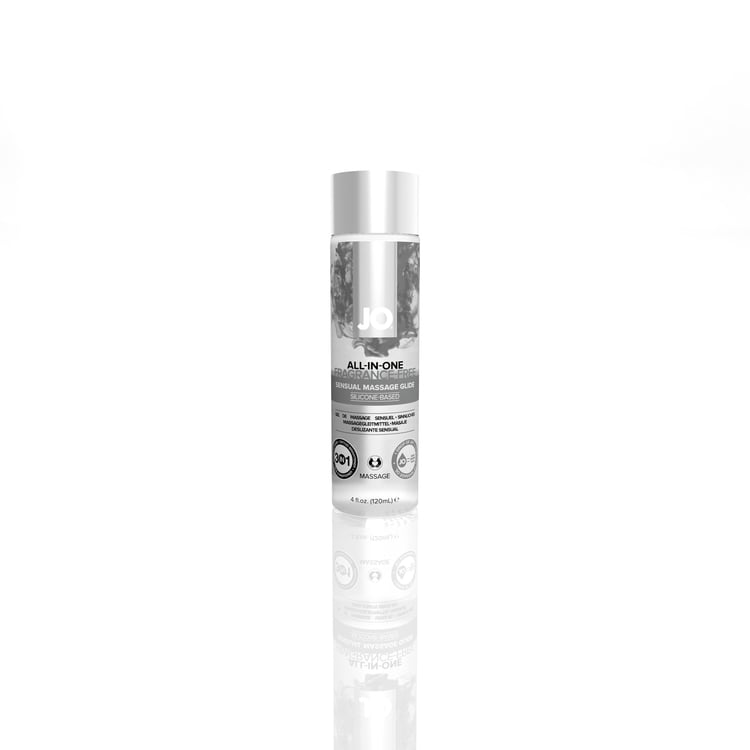
Jo All-In-One Fragrance Free — silicone-based, so it lasts far longer on skin but must be kept away from silicone toys. Choose silicone-based for a genuine full-body massage with no condoms and no silicone toys involved. Silicone does not absorb into skin, so one application lasts the whole session — by a wide margin the longest-lasting of the three.
Jo All-In-One Fragrance Free at $8.99 is fragrance-free, which matters if you or your partner react to scented products. The manufacturer also lists it as a skin conditioner and tattoo brightener.
The catch is the same one that applies to silicone lubricant generally: silicone glide and silicone toys are the same polymer family, and prolonged contact leaves the toy surface permanently tacky. Our lube compatibility guide and material care guide both cover this in more detail.
Who should choose an oil?
Almond Glow, 8 oz. A true oil blend — long-lasting and skin-conditioning, but it contains peanut and lanolin oils and must be kept away from latex. Choose an oil for a long massage where skin conditioning is the point and no latex is involved. Oils last, they feel richer than either glide, and they leave skin softer.
Almond Glow Body Lotion Massage Oil at $9.99 is an 8 oz bottle — much larger than the 1 oz glides, and better value for actual full-body massage.
Two warnings, and we would rather lead with them than bury them.
It contains peanut oil and lanolin. The blend is peanut, olive and lanolin oils with vitamin E. If either you or your partner has a nut allergy, do not use it, and check any oil blend's ingredients before it goes on skin. Lanolin is also a recognised contact allergen for some people.
Oil weakens latex. Mineral and vegetable oils degrade latex condoms and raise the chance of breakage. If there is any possibility of a latex condom being used, choose a different base.
Buying rule: patch-test any new oil blend on a small area of forearm before using it over a large area, and read the full ingredient list — not the marketing line on the front.
What about essential oils?
Essential oils are a different category, and they are routinely misused.
They are highly concentrated plant extracts and are not massage oils. Applied neat they can cause irritation and contact dermatitis. Published guidance puts typical safe dilution at roughly 2–5% in a carrier oil, dropping to around 0.5% for the more irritating oils.
Sensitisation is uncommon but real. In one patch-test series covering twelve essential oils across 10,930 dermatitis patients, 8.3% reacted to at least one, with ylang-ylang, lemongrass, jasmine, sandalwood, clove and neroli each producing reactions in more than 1%.
Aura Cacia Black Pepper Warming essential oil at $13.30 is a 0.5 fl oz bottle of pure essential oil. It is an ingredient to be blended into a carrier, not something to pour onto skin.
Practical rule: a few drops of essential oil into a tablespoon of carrier oil is roughly the right order of magnitude. If you cannot work out the dilution, use a ready-blended massage oil instead.
Where they are identical
- All three feel good. Nobody chooses badly on texture alone; the compatibility issues are what actually go wrong.
- All three stain something. Oils are worst, silicone is intermittent, water-based is mildest — but a towel is sensible for any of them.
- None is a substitute for reading the label. Whether a product is safe as a personal lubricant is a labelling question, not a base-type question.
- All three should be patch-tested if you have sensitive skin or a known allergy.
What we can't confirm
- We have not tested any of these products ourselves. Compatibility guidance follows from material chemistry and manufacturer labelling.
- Ingredient lists change without notice. Read the bottle you receive, especially for allergens.
- Not every massage product is validated as a lubricant. Where a manufacturer does not state internal use, we will not assume it.
- The essential-oil dilution range is general guidance, not a per-oil prescription. Individual oils vary and some require far greater dilution.
- Product availability in this category moves quickly. Prices and stock were verified on 14 August 2026.
When should you speak to a clinician?
Stop and seek advice if you notice:
- A rash, hives, burning or spreading redness after use
- Swelling, difficulty breathing or throat tightness — seek emergency care immediately, as this can indicate an allergic reaction
- Irritation that does not settle within a day or two of stopping
- Any reaction after using a product containing nut oils, if you have a known nut allergy
Patch-testing a new product on a small area first is the simplest way to avoid all of this.
Common myths
"Massage oil and lubricant are interchangeable." Sometimes, but only when the label says so. Formulation and testing differ.
"Natural oils are automatically safer." Peanut, almond and lanolin are all natural and all recognised allergens. Natural describes origin, not safety.
"Essential oils are just strong massage oils." They are concentrated extracts requiring dilution into a carrier before skin contact.
"Warming products are just scented oils." Warming agents are additional active ingredients and a common cause of irritation for people prone to it.
Frequently asked questions
Can I use massage oil with condoms?
Not with latex condoms. Oils weaken latex and raise breakage risk. Use a water-based or silicone-based product instead.
Can I use a silicone massage glide with silicone toys?
No. They are the same polymer family and prolonged contact permanently damages the toy surface. Use water-based.
What is the difference between a massage glide and a massage oil?
A glide is water- or silicone-based and usually doubles as a personal lubricant. An oil is a true oil blend — longer lasting and more conditioning, but incompatible with latex.
Do I need to dilute essential oils?
Yes. Published guidance is roughly 2–5% in a carrier oil, lower for irritating oils. Neat application can cause contact dermatitis.
Which massage product is safest for sensitive skin?
A fragrance-free water-based or silicone-based glide, patch-tested first. Fragrance and warming agents are the usual triggers.
Will these stain my sheets?
Oils frequently, silicone sometimes, water-based rarely. Use a towel regardless.
Can I use massage oil as a lubricant?
Only if the label states it. Many massage oils are not formulated or tested for that use.
Sources and further reading
- Mineral oil lubricants cause rapid deterioration of latex condoms
- The Influence of Carrier Oils on the Antimicrobial Activity and Cytotoxicity of Essential Oils
- Assessing the skin sensitization potential of essential oils
- Advances in plant essential oils and drug delivery systems for skincare
Related reading: our lube compatibility guide and material care guide.
About this guide
Written by the Gear Isle product team, West Sacramento, CA. Ingredients, prices and availability were verified against our catalogue on 14 August 2026 and are subject to change. Always read the ingredient list on the bottle you receive.
This article is for general information and is not medical advice. If you have a known allergy — particularly a nut allergy — check ingredients before use and consult a healthcare provider about any reaction. Seek emergency care for swelling or difficulty breathing.
-
Mack Tuff Dual Power Ring Review: Specs, Sizing, Safety
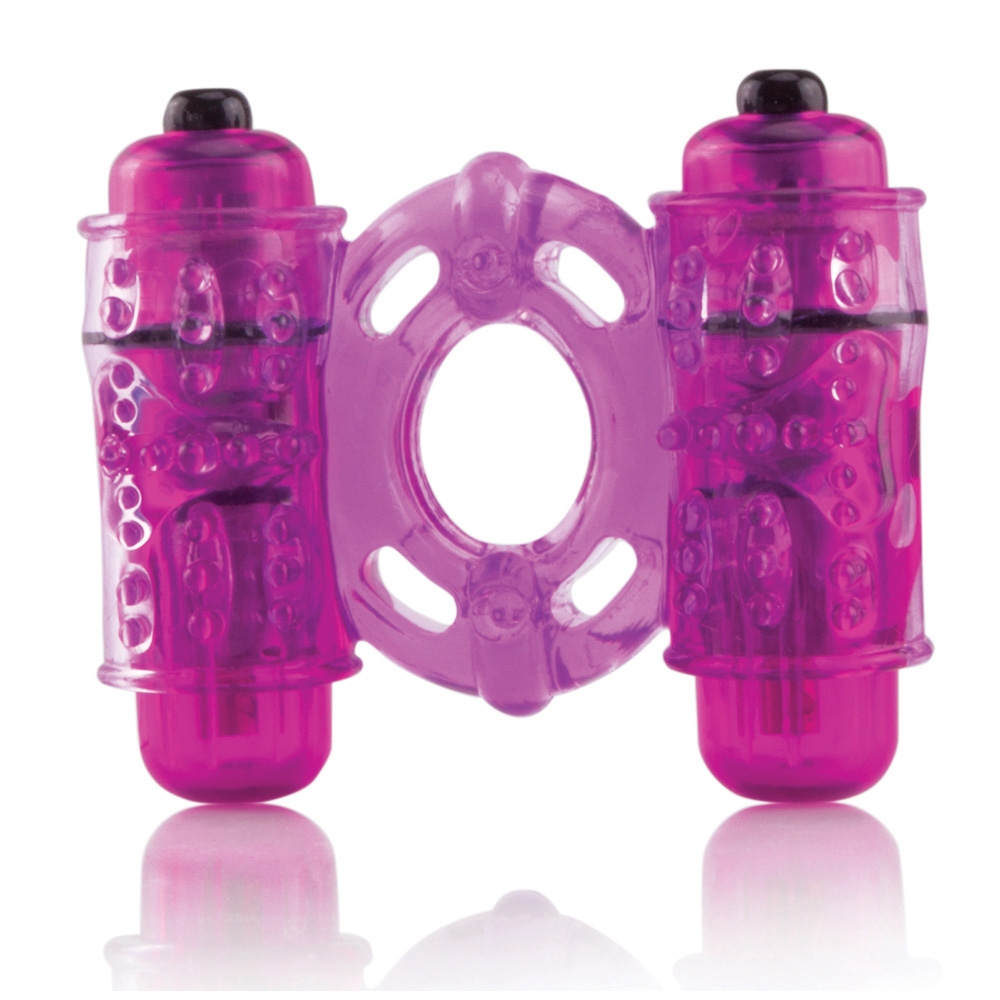
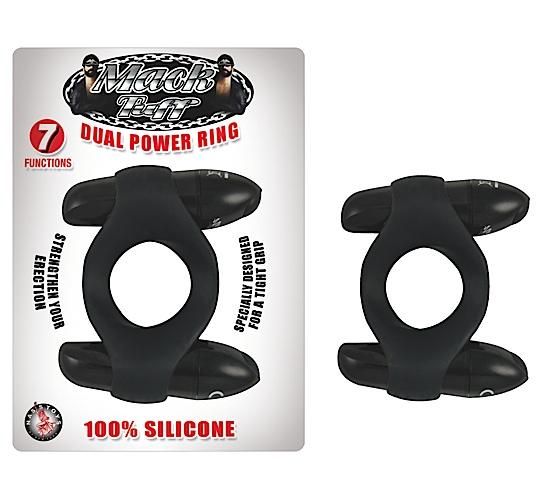
The Mack Tuff Dual Power Ring is a battery-powered dual-bullet vibrating ring at $25.99. The ring is 100% silicone, the two bullets are ABS plastic, and six LR44 batteries are included. It is listed as waterproof with no IP rating published, and the stated ring diameter carries no unit.
The Mack Tuff Dual Power Ring — silicone ring body with two ABS bullet motors, one positioned above and one below. Key takeaways
- Battery-powered, not rechargeable. Six LR44 (AG13) cells are included. That is a genuine difference from most rings at this price and above.
- Two separate bullets, seven functions. Each bullet has its own EZ push-button.
- Mixed materials. The ring is 100% silicone; the bullets are ABS. Care rules differ between the two parts.
- Phthalate-free and RoHS compliant, per the manufacturer.
- "Waterproof" with no IP rating — the same unverifiable claim we cover in our waterproofing guide. Treat it as splash-safe.
- The published internal diameter is "3.5" with no unit stated. We will not guess at it. See the sizing section below.
- The 20–30 minute wear limit applies, exactly as it does to any constriction ring.
What's on this page
- What you actually get
- The sizing problem
- Is it really waterproof?
- How do you care for a mixed-material ring?
- How does it compare to the alternatives?
- What we can't confirm
- When should you speak to a clinician?
- Common myths
- FAQ
- Sources
What you actually get
Every figure below is taken from the manufacturer's published specification.
Specification Mack Tuff Dual Power Ring Price $25.99 Functions 7 Motors 2 bullets, each with an EZ push-button Ring material 100% silicone Bullet material ABS plastic Bullet length 2.75" each Internal ring diameter 3.5 — unit not stated Power 6 × LR44 (AG13) batteries, included Rechargeable No Water resistance Listed waterproof; no IP rating published Phthalate-free Yes RoHS compliant Yes Distributor Novelties By Nasswalk (Nasstoys), North Bergen, NJ The dual-bullet layout is the point of this product. One bullet sits above the ring and one below, so vibration reaches both partners rather than one. Each is independently controlled by its own button, which is more useful in practice than a single seven-mode cycle would be.
Batteries being included is worth noting at this price. LR44 cells are cheap but fiddly to source in a hurry, and plenty of comparable rings arrive without them.
Practical rule: buy a spare pack of LR44 (AG13) cells at the same time. Six is a full set for both bullets, and a dead bullet mid-session is the most common complaint about any battery-powered ring.
The sizing problem
This is the honest problem with the listing, and it is worth being direct about.
The manufacturer publishes an internal ring diameter of "3.5" and does not state whether that is inches or centimetres. Those two readings are wildly different: 3.5 cm is roughly 1.38 inches, which is a normal cock ring size. 3.5 inches would be far larger than any standard ring.
We are not going to guess which one it is, and we would rather say so than publish a number we cannot stand behind. If exact sizing matters to your purchase — and with a non-stretch-rated ring it should — contact us before ordering and we will ask the supplier for a confirmed measurement in a stated unit.
In the meantime, the general sizing method still applies: measure your base circumference while erect, divide by 3.14 for diameter, and choose slightly smaller for a stretchy silicone ring. Our cock ring sizing and safety guide covers the method and the warning signs in full.
Buying rule: if you have never worn a ring, a stretchy multi-size kit is a better first purchase than any single ring — including this one. Sizing is guesswork otherwise, and this listing does not remove the guesswork.
Is it really waterproof?
The manufacturer lists it as waterproof. No IP rating is published, which means there is no tested depth or duration behind the word.
This is the same situation we examined in detail for another product in our guide to what "waterproof" actually means: "waterproof" on its own is not defined by any standard, whereas an IP code from IEC 60529 maps to a specific laboratory test.
There is an additional wrinkle here. This ring takes replaceable batteries, which means a battery compartment, which means a seal that is opened and closed repeatedly. Compartment seals on inexpensive battery-powered products are the most likely point of water entry, and they degrade with each opening.
Practical rule: treat it as splash-safe and rinse-safe. Do not submerge it, and make sure the battery compartment is fully closed and dry before it goes anywhere near water.
How do you care for a mixed-material ring?
Mixed-material products need mixed-material care, and this is where people damage them.
The silicone ring: never use silicone lubricant on it. Silicone lube and silicone products are the same polymer family and prolonged contact permanently degrades the surface. Water-based lubricant only. Our lube compatibility guide covers this across every lube type.
The ABS bullets: ABS is a hard, non-porous plastic. It wipes clean easily, but it contains the motor and the battery compartment, so it must never be submerged, boiled or put in a dishwasher.
Clean with warm water and a mild unscented soap, or a purpose-made toy cleaner, and dry thoroughly — particularly around the bullet housings where water sits. Our material care guide has the full routine per material.
How does it compare to the alternatives?
All four below are in stock as of August 2026. Every row is a decision factor.
Dual Power Ring Tire Ring XL Cock Tie CocksWellers Price $25.99 $14.99 $8.99 $14.99 Vibration Yes, 2 bullets, 7 functions No No No Material Silicone + ABS 100% silicone Silicone 100% silicone Adjustable No No Yes No Batteries needed Yes, 6 × LR44 (included) No No No Best suited to Couples wanting shared vibration A larger plain fit Uncertain sizing A plain silicone ring If sizing is your worry, the Adjustable Silicone Cock Tie at $8.99 removes the problem entirely — it adjusts rather than relying on a fixed diameter. If you want a plain non-vibrating ring, the Tire Ring XL at $14.99 or CocksWellers at $14.99 are cheaper. The Dual Power Ring earns its extra cost only if you specifically want the two-motor vibration.
For a broader look at stretchy silicone rings across brands, see our Oxballs comparison.
What we can't confirm
- The internal diameter unit is not published. "3.5" could be centimetres or inches. We will not state which.
- No IP rating exists for the waterproof claim.
- Battery life is not published. LR44 cells in small motors are generally short-lived, but the manufacturer gives no figure and we have not measured it.
- We have not tested this product. Everything here comes from the published specification and general handling of these materials.
- Stock is limited. We hold a small number of units; availability may change quickly.
When should you speak to a clinician?
Remove the ring immediately if you notice numbness, tingling, coldness, or skin turning pale, blue, grey or dark.
Seek emergency care if a ring cannot be removed and swelling is increasing, if pain is severe, if you cannot urinate, or if sensation does not return after removal. Delay is what turns a recoverable episode into lasting damage.
The 20–30 minute limit applies to this ring exactly as it does to any other. Vibration does not change what a constriction ring does to circulation.
Recurring difficulty getting or keeping an erection is a clinical question rather than a shopping one, and worth raising with a healthcare provider.
Common myths
"A vibrating ring is gentler than a plain one." The ring component behaves identically. Every wear-time limit applies.
"Waterproof means you can submerge it." Not without an IP rating, and especially not with a battery compartment.
"More functions means better." Seven functions on two independent buttons is genuinely useful. Function counts on a single motor usually are not.
"Silicone lube is fine because part of it is plastic." The ring is silicone. Silicone lube will damage it regardless of what the bullets are made from.
Frequently asked questions
Is the Mack Tuff Dual Power Ring rechargeable?
No. It takes six LR44 (AG13) batteries, which are included. There is no USB charging.
What size is the Mack Tuff Dual Power Ring?
The manufacturer publishes an internal diameter of 3.5 but does not state the unit. Contact us before ordering if exact sizing matters and we will request a confirmed measurement.
How many motors does it have?
Two independent bullets, one above and one below the ring, each with its own push-button, across seven functions.
Is it waterproof?
It is listed as waterproof, but no IP rating is published and it has a battery compartment. Treat it as splash-safe rather than submersible.
What lubricant can I use with it?
Water-based only. The ring is silicone, and silicone lubricant permanently degrades silicone surfaces.
How long can I wear it?
Standard guidance is 20 to 30 minutes maximum, and never while asleep. Vibration does not change that limit.
Are the bullets removable?
The specification lists two bullets of 2.75" each as separate components with their own controls. It does not state whether they detach fully, so we will not claim that they do.
Sources and further reading
- Treatment Options and Outcomes of Penile Constriction Devices
- Penile and Scrotal Strangulation due to Metal Rings: Case Reports and a Review
- IEC 60529 — Degrees of protection provided by enclosures (IP Code)
Related reading: our cock ring sizing and safety guide, the Oxballs ring comparison, and our material care guide. Browse the full cock rings category for current stock.
About this guide
Written by the Gear Isle product team, West Sacramento, CA. Specifications are quoted from the manufacturer's published listing and were verified against our catalogue on 14 August
- Where the manufacturer does not state a figure — or, as with the ring diameter, states one without a unit — we say so rather than estimate.
This article is for general information and is not medical advice. Wear-time guidance is drawn from published clinical literature and is a ceiling, not a target. Consult a healthcare provider about pain, numbness or colour change, and seek emergency care if a device cannot be removed.
-
Sex Toy Care by Material: Silicone, TPE, UR3, Glass, Steel
Identify the material first, because the right cleaning method for one is the wrong one for another. Silicone tolerates hot water and detergent. UR3 and cyberskin need drying and a dusting of renewal powder. Porous materials cannot be fully sanitised, only cleaned.
Key takeaways
- Material determines everything — cleaning method, lubricant, storage and lifespan. Nothing else about care matters as much.
- Non-porous materials can be sanitised. Porous ones cannot. Silicone, glass and steel are non-porous. TPE, TPR, UR3, cyberskin and jelly are porous to some degree.
- UR3 and cyberskin need renewal powder after drying, or the surface turns tacky and starts to degrade.
- Clean promptly, not aggressively. Biofilm gets markedly harder to remove the longer it is left, and harsh cleaners are not a substitute for doing it soon.
- Never store toys touching each other. Different polymers react, and a soft toy pressed against another can be permanently marked.
- Silicone lube ruins silicone toys. The single most expensive mistake in this article.
- Materials degrade whatever you do. Peer-reviewed testing found phthalates in every product sampled and measurable microplastic release under abrasion. Replacement is part of care, not a failure of it.
What's on this page
- How do you identify the material?
- The care table
- How do you clean each material?
- How should you store them?
- Why material matters beyond hygiene
- What we can't confirm
- When should you replace a toy?
- Common myths
- FAQ
- Sources
How do you identify the material?
If the packaging is gone, three quick checks get you most of the way.
- The drag test. Run a dry finger across it. Silicone drags slightly and feels matte. TPE and UR3 feel slicker and softer, almost skin-like. Glass and steel are cold and frictionless.
- The smell test. Quality silicone is odourless. A faint plasticky or vinyl smell points to TPE, PVC or jelly.
- The weight test. Steel is unmistakably heavy. Glass is heavier than it looks. Everything else is light.
If you genuinely cannot tell, treat it as porous. That assumption is never unsafe — it just means more caution than strictly necessary.
Practical rule: if you cannot identify the material, use warm water and mild unscented soap, dry it completely, and use a condom with it if it is shared.
The care table
This is the reference. Every row is drawn from manufacturer guidance and general polymer handling; where something is not established, the table says so rather than guessing.
Silicone TPE / TPR UR3 / cyberskin Glass Steel Porous No Slightly Yes No No Can be sanitised Yes Partly No — clean only Yes Yes Warm water + mild soap Yes Yes Yes Yes Yes Boiling Only if fully non-electronic No No Usually yes Yes Dishwasher Some non-electronic pieces Varies by product No Usually yes Yes Water-based lube Yes Yes Yes Yes Yes Silicone lube No — degrades surface Yes Generally avoid Yes Yes Needs renewal powder No No Yes, after drying No No Share without a condom Acceptable if sanitised Not advised Not advised Acceptable if sanitised Acceptable if sanitised Typical lifespan Longest Medium Shortest Indefinite Indefinite Never put anything containing a battery or motor in boiling water or a dishwasher, regardless of what the outer material is.
How do you clean each material?
Silicone
The most forgiving material, and the most common — the great majority of our in-stock range is silicone. Warm water and a mild, unscented soap is enough for routine cleaning. Fully non-electronic silicone pieces can be boiled.
The one hard rule is lubricant: silicone lube and silicone toys are the same polymer family, and prolonged contact leaves the surface permanently tacky and porous. Our lube guide covers compatibility across every lube type.
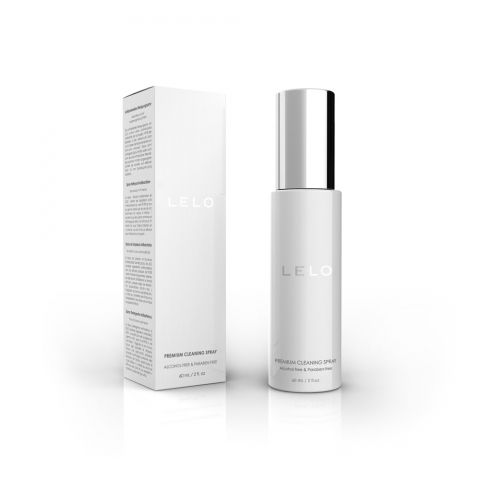
Alcohol-free, pH-balanced cleaners are the safer default. Alcohol dries and degrades most soft materials. A dedicated cleaner is worth it for anything with a motor, seams or a suction chamber where soap is hard to rinse out. The Lelo Antibacterial Cleaning Spray at $9.75 is alcohol-free and pH-balanced, and Wicked Cleene Antibacterial Unscented at $11.99 is a fragrance-free option if you react to scented products.
TPE and TPR
Thermoplastic elastomers sit between silicone and the realistic materials. Quality phthalate-free TPR — the kind used in the Oxballs rings we compared here — cleans well with detergent and hot water, and some products explicitly permit dishwasher cleaning. Check the specific product; this varies more than any other material.
TPE takes silicone lubricant without harm, which is one of its genuine advantages over silicone.
UR3, cyberskin and realistic skin materials
UR3 Refresh Powder. Renewal powder is not optional maintenance for these materials — it is the step that stops the surface going tacky. These are the highest-maintenance materials, and the ones people most often ruin by treating them like silicone.
The routine is specific:
- Rinse in warm water with a mild unscented soap. No alcohol, no harsh cleaner.
- Pat dry — do not rub — and let it air-dry completely. Trapped moisture is what starts the degradation.
- Dust with renewal powder while dry. This is the step people skip. Without it the surface becomes tacky, then sticky, then starts breaking down.
UR3 Refresh Powder by Doc Johnson at $8.99 is the maintenance product made for this. Cornstarch is sometimes suggested as a substitute; we would not, because it is an organic material sitting on a porous surface.
Practical rule: UR3 and cyberskin are porous and cannot be sanitised. If a toy in one of these materials is shared, use a condom on it. That is the only reliable answer.
Glass and steel
The easiest of all. Both are non-porous, both take any lubricant, both can be sanitised properly with boiling water or a dishwasher, and neither has a meaningful lifespan limit.
The only real care issue is physical: inspect glass before every use for chips or cracks, and stop using it immediately if you find either. Store both away from harder objects that could knock them.
How should you store them?
Storage causes more material damage than cleaning does, and it gets almost no attention.
- Keep pieces separated. Different polymers react with each other on contact. A silicone toy left pressed against a TPE one can leave both permanently marked.
- Dry completely before storing. Sealing away anything damp is how you grow the problem you just cleaned off.
- Avoid heat and direct sunlight. Both accelerate polymer breakdown.
- Use individual bags or a compartmented case rather than a shared drawer. A storage case at $29.99 solves separation and dust in one.
A compartmented case solves the two storage problems at once: pieces stay separated, and dust stays out. - Store batteries removed or partially charged, not fully flat, for anything rechargeable you are putting away for months.
Why does material matter beyond hygiene?
There is a more uncomfortable dimension to material choice, and we would rather cover it than pretend cleaning is the whole story.
A 2023 study in *Microplastics and Nanoplastics*, Bringing sex toys out of the dark: exploring unmitigated risks by Sipe and colleagues, tested a set of products and reported two findings worth knowing. Phthalates — plasticisers associated with endocrine effects — were detected in the products sampled. And abrasion testing produced measurable micro- and nanoplastic release, with anal toys and beads releasing most and external vibrators least.
The honest framing: this was a small study, it does not establish a health outcome in people, and it does not mean any specific product you own is unsafe. What it does support is practical. Prefer non-porous materials where you have the choice. Do not use a toy that has become tacky, sticky or is visibly shedding surface. And treat replacement as normal maintenance rather than waste.
Buying rule: if you are choosing between an inexpensive porous toy and a slightly dearer silicone, glass or steel one you will keep for years, the second is usually the better purchase on every axis — hygiene, lifespan and material stability.
What we can't confirm
- We have not lab-tested any of our range. Material guidance here comes from manufacturer specifications and general polymer handling, not our own testing.
- "TPE" and "TPR" cover a wide range of formulations. Two products with the same material name can behave differently. Follow the specific product's instructions where they exist.
- Lifespans are not published for most of these materials. "Longest" and "shortest" in the table above are relative, not measured figures.
- The phthalate study is one small study. It sampled a limited set of products and did not measure health outcomes in people. We have described what it found, not extrapolated from it.
- Boiling and dishwasher guidance varies by product. Where a manufacturer says no, the manufacturer wins over this table.
When should you replace a toy?
Stop using and replace any toy that shows:
- A surface that has turned tacky, sticky or gummy and does not recover after cleaning
- Visible cracks, splits, tears or chips — in any material, but critically in glass
- Discolouration or a persistent smell that survives cleaning
- Any change in texture, softening or weeping of oils
- Damage to a seam or a charging port on an electronic item
None of these are salvageable. A degraded porous surface cannot be cleaned back to safe.
Common myths
"Antibacterial soap is the safest cleaner." In published testing of cleansing agents on silicone biofilm, ordinary antibacterial soap was among the *least* effective against established biofilm. Cleaning promptly beats cleaning harder.
"Boiling works for everything." It destroys electronics, damages TPE and ruins UR3. It is only appropriate for solid non-electronic silicone, glass and steel.
"Porous toys are fine if you clean them well." Cleaning reduces surface contamination. It does not sanitise a porous material. That is why a condom is the answer for sharing.
"Alcohol is a good sanitiser for toys." It dries and degrades most soft materials. Use a purpose-made cleaner or mild soap and water.
"If it still looks fine it is fine." Surface degradation in porous materials starts before it is visible. Texture change is the earlier signal.
Frequently asked questions
How do I clean UR3 or cyberskin?
Warm water and mild unscented soap, pat dry, air-dry fully, then dust with renewal powder. Skipping the powder is what makes the surface turn tacky.
What is UR3 refresh powder for?
It restores the dry, skin-like surface of UR3 and similar realistic materials after washing, and stops the material becoming sticky as it ages.
Can I boil a silicone toy?
Only if it contains no electronics or battery. Boiling any motorised item will destroy it.
Which materials can actually be sanitised?
Silicone, glass and steel — all non-porous. TPE and TPR only partly. UR3 and cyberskin cannot be sanitised, only cleaned.
Can I use silicone lube on a silicone toy?
No. They are the same polymer family and prolonged contact permanently degrades the surface. Use water-based.
Why can't toys be stored touching each other?
Different polymers react on contact and can leave permanent marks or soft spots. Store each piece separately.
How long should a toy last?
Glass and steel effectively indefinitely; silicone for years; TPE and UR3 considerably less. No manufacturer publishes a figure, so replace on condition rather than on a date.
Sources and further reading
- Bringing sex toys out of the dark: exploring unmitigated risks (Sipe et al., Microplastics and Nanoplastics, 2023)
- Efficacy of cleansing agents in killing microorganisms in mixed species biofilms on silicone
- Biofilm formation by Candida species on silicone surfaces and latex
- Microbial growth and adhesion of E. coli in elastomeric silicone foams
Related reading: our lube compatibility guide, the Oxballs material comparison, and what "waterproof" actually means for cleaning anything with a charging port.
About this guide
Written by the Gear Isle product team, West Sacramento, CA. Product availability and prices were verified against our catalogue on 14 August 2026 and are subject to change. Where a manufacturer publishes no figure — lifespan, in particular — we say so rather than estimate.
This article is for general information and is not medical advice. Consult a healthcare provider about irritation, unusual discharge, or any symptom that follows use of a product.
-
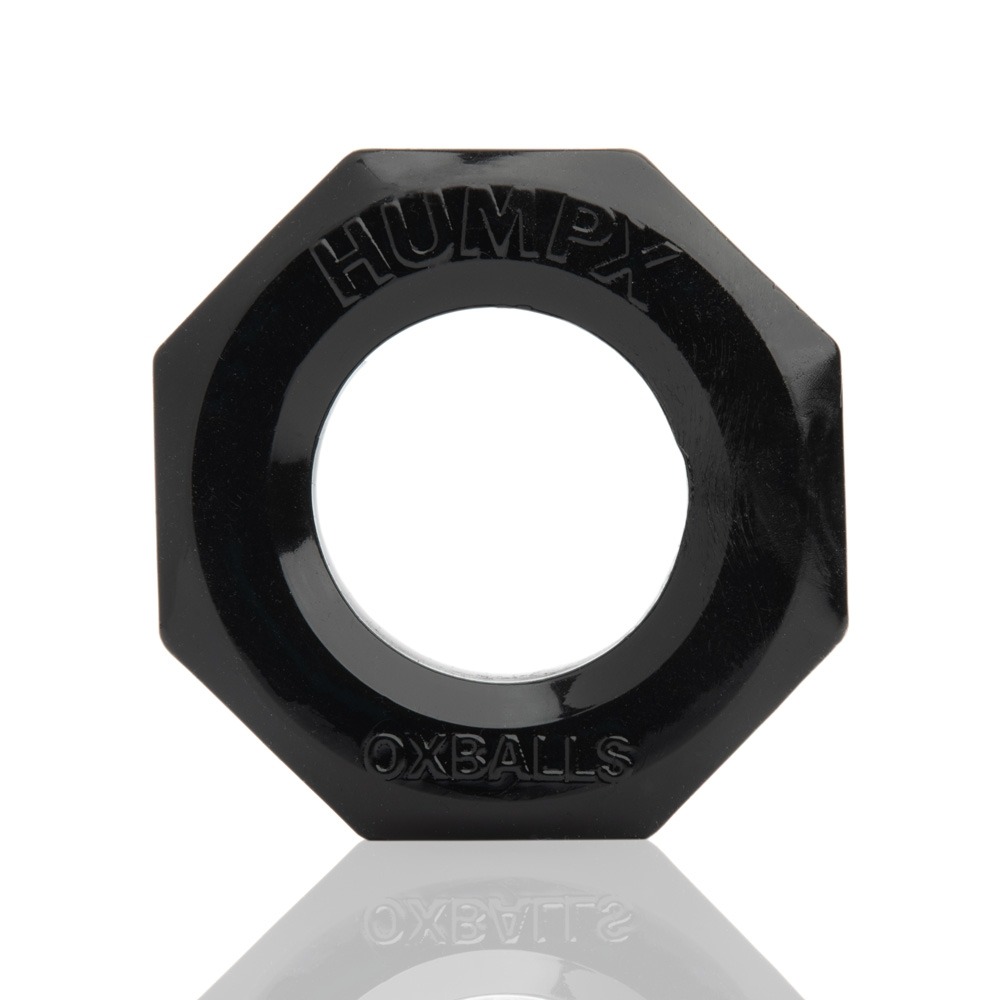
Oxballs Cock Rings: Humpx vs Jelly Bean vs Cock Lug
All three are stretchy, comfortable rings from the same maker, and all three resist rolling. The decision comes down to material: Cock Lug is silicone, so it needs water-based lube only. Humpx and Jelly Bean are TPR and work with any lube, including silicone.
Key takeaways
- Material is the real difference. Cock Lug is pure silicone. Humpx and Jelly Bean are TPR. Everything else between them is preference.
- Silicone rings and silicone lube do not mix. If your lube drawer is silicone-based, Cock Lug is the wrong pick unless you buy water-based alongside it.
- Humpx is the only one with published dimensions — 0.5" depth, 6" outer circumference. The others state less, and we will not invent figures.
- Jelly Bean is the easiest to clean. Its spec explicitly allows detergent, hot water and a dishwasher.
- Cock Lug costs most at $25.00 and is the plushest; Humpx is cheapest at $13.50.
- The 30-minute rule applies to all three equally. Material changes comfort, not the safe wear time.
- Buy a multi-size kit first if you have never worn one. Sizing is guesswork otherwise.
What's on this page
- The short answer
- At a glance
- Who should choose Humpx?
- Who should choose Jelly Bean?
- Who should choose Cock Lug?
- Where they are identical
- What we can't confirm
- When should you speak to a clinician?
- Common myths
- FAQ
- Sources
The short answer
Pick Cock Lug unless you already own silicone lube
Cock Lug is the most comfortable of the three and the one most people will get on with — but it is silicone, so silicone lubricant is out. If your lube is silicone-based, or you want the widest stretch for the lowest price, buy Humpx instead. Choose Jelly Bean if easy cleaning and lube flexibility matter more than plushness.
At a glance
Every row below is a decision factor, not a feature list.
Humpx Jelly Bean Cock Lug Price $13.50 $15.00 $25.00 Material FLEXtpr (TPR) Thermoplastic rubber (TPR) Pure silicone Water-based lube Yes Yes Yes Silicone lube Yes Yes No — degrades the ring Oil-based lube Yes Yes Not advised Published dimensions 0.5" depth, 6" outer circ. Total length 1 7/8" Not published Stretch Super-soft, very stretchy Medium-firm Plush, very stretchy Anti-roll design Flat inner surface Shallow inner channel Textured grip Dishwasher safe Not stated Yes, per spec Not stated Doubles as a ball stretcher Yes, stackable Yes, as a short ball ring Not stated Distinctive feature Widest stretch, lowest price Six colours, easiest cleaning External lugs, most cushioned Safe wear time 20–30 min 20–30 min 20–30 min Who should choose Humpx?
Humpx — the widest stretch of the three, and the only one with published dimensions. Choose Humpx at $13.50 if you want the most forgiving fit for the least money, or if you are not confident about sizing yet.
It is the only ring here with dimensions published by the manufacturer: 0.5 inches deep with a 6-inch outer circumference. That matters more than it sounds, because it is the one case where you can compare against a measurement rather than a marketing adjective.
The inner surface is flat rather than round, which is what stops it rolling or catching. Oxballs also states it can be stacked and worn as a ball stretcher, so it has a second use.
Being TPR, it takes any lubricant — water-based, oil-based, hybrid or silicone.
Buying rule: if you are choosing your first ring and are unsure of size, buy the Bonemaker 3-pack at $19.99 instead of a single ring. Three sizes for the price of one guess.
Who should choose Jelly Bean?
Jelly Bean — medium-firm TPR, and the only one of the three whose spec explicitly allows dishwasher cleaning. Choose Jelly Bean at $15.00 if you want a firmer ring than Humpx and the least fuss when cleaning.
Its specification is the most explicit of the three on the practical questions. It is phthalate-free TPR. It is compatible with every lubricant type — water, oil, hybrid and silicone. And it is the only one that names the dishwasher as an acceptable cleaning method, alongside detergent and hot water.
The stretch is described as medium-firm rather than super-soft, so it holds a more defined shape than Humpx. A shallow channel inside keeps it seated. It comes in six colours, and Oxballs notes it also works as a short ball ring.
Who should choose Cock Lug?
Cock Lug — pure silicone with external lugs. The most cushioned, and the one that rules out silicone lubricant. Choose Cock Lug at $25.00 if comfort over a longer session matters more than price, and your lubricant is water-based.
It is the only pure-silicone ring of the three. Silicone feels plusher and more skin-like than TPR, and Cock Lug adds external lugs — soft nubs on the outside that hold it slightly away from the body and reduce the contact area.
The material is also the catch. Silicone lubricant and silicone toys are the same polymer family, and prolonged contact leaves the surface tacky and permanently porous. Our lube guide covers the compatibility rules in full.
Practical rule: if you own silicone lube and do not want to keep track of which product goes with which ring, buy TPR. One material, no compatibility decisions.
Where they are identical
We would rather tell you where the differences stop than manufacture some.
- All three are stretchy pull-on rings. None is rigid, and none requires a fastening.
- All three are designed not to roll. Humpx uses a flat inner face, Jelly Bean a shallow channel, Cock Lug its texture. Different solutions, same outcome.
- All three carry the same safe wear time. 20 to 30 minutes, never while asleep. Material affects comfort, not circulation.
- All three can be cut off in an emergency, because all three are soft. This is the single most important thing they share, and it is what separates any of them from a metal ring.
- All three are body-contact soft polymers from the same manufacturer, at broadly the same quality level.
If your priority is simply "a comfortable soft cock ring that will not trap me", any of the three does that job. The comparison only matters once lube, budget or cleaning enters it.
What we can't confirm
- Cock Lug's dimensions are not published. Oxballs describes it as fitting any size but gives no measurement. We will not estimate one.
- Internal diameters are not published for any of the three. Only Humpx gives an outer circumference and depth. Sizing guidance here is general, not product-specific.
- We have not lab-tested material compatibility. The silicone-lube warning follows from polymer chemistry and manufacturer guidance, not from our own testing.
- Colour availability changes. Jelly Bean is listed in six colours; stock varies.
- We have not compared durability over time. Nobody has published wear data for these, and we are not going to guess at lifespan.
When should you speak to a clinician?
Remove the ring immediately if you notice numbness, tingling, coldness, or the skin turning pale, blue, grey or dark.
Go to an emergency department if a ring will not come off and swelling is increasing, if pain is severe, if you cannot urinate, or if sensation has not returned after removal. Delay is what turns a recoverable episode into lasting damage. Our cock ring safety guide covers wear time, sizing and warning signs in detail.
Recurring difficulty getting or keeping an erection is a clinical question, not a shopping one. Speak to a healthcare provider rather than buying a tighter ring.
Common myths
"Silicone is always better than TPR." Silicone feels plusher and is easier to sanitise. TPR is more lube-flexible and cheaper. Neither is universally better.
"A more expensive ring is safer." Price tracks material and design, not safety. All three carry the same wear-time limit.
"TPR is porous and unhygienic." Quality phthalate-free TPR of the kind Oxballs uses cleans well with detergent and hot water. The porosity concern applies to cheap jelly rubber, which is not the same material.
"You can use any lube with any toy." This is the one that actually costs money. Silicone lubricant will ruin a silicone ring, permanently.
Frequently asked questions
What is the difference between Humpx, Jelly Bean and Cock Lug?
Material and fit. Cock Lug is pure silicone and the most cushioned. Humpx and Jelly Bean are TPR — Humpx stretchier, Jelly Bean firmer and easier to clean.
Can I use silicone lube with Oxballs cock rings?
With Humpx and Jelly Bean, yes — both are TPR. Not with Cock Lug, which is silicone and would be degraded by it.
Which Oxballs ring should a beginner buy?
Humpx has the widest stretch and lowest price at $13.50. If you are unsure of size, the Bonemaker 3-pack at $19.99 gives you three sizes to try.
How long can I wear an Oxballs cock ring?
Standard guidance is 20 to 30 minutes maximum, and never while asleep. That applies equally to all three.
Can these be used as ball stretchers?
Oxballs states Humpx can be stacked and worn as a stretcher, and that Jelly Bean works as a short ball ring. Cock Lug does not state this.
How do I clean them?
Warm water and mild detergent for all three. Jelly Bean's specification additionally allows dishwasher cleaning; the other two do not state it.
What size should I buy?
Measure the base circumference while erect and divide by 3.14 for diameter, then choose roughly 5–10% smaller for a stretchy ring. A multi-size kit removes the guesswork.
Sources and further reading
- Treatment Options and Outcomes of Penile Constriction Devices
- Penile and Scrotal Strangulation due to Metal Rings: Case Reports and a Review of the Literature
- Penile strangulation injury by metallic ring: a study of 4 cases
Related reading: our cock ring safety guide and our lube compatibility guide. Browse the full cock rings category for current stock.
About this guide
Written by the Gear Isle product team, West Sacramento, CA. Materials, dimensions and prices were taken from manufacturer specifications and verified against our catalogue on 14 August 2026. Where a manufacturer publishes no figure, we say so rather than estimate.
This article is for general information and is not medical advice. Wear-time guidance is drawn from published clinical literature and is a ceiling, not a target. Consult a healthcare provider about pain, numbness or colour change, and seek emergency care if a device cannot be removed.
-
Silicone Cock Rings: Sizing, Safe Wear Time and Material
A cock ring restricts blood leaving the penis. Standard guidance is to wear one for no more than 20 to 30 minutes, never while asleep, and to remove it immediately if you notice numbness, coldness or colour change. Stretchy silicone is the safer material because it can be cut off in an emergency. Metal cannot.
Key takeaways
- 30 minutes is the working limit. Medical case reports describe genital incarceration when constriction devices are left on beyond roughly half an hour.
- Material is a safety decision, not a style one. Almost every strangulation case in the urological literature involves a rigid metal ring.
- Silicone can be cut off with scissors. Metal rings have required ring cutters, bolt cutters, orthopaedic saws and angle grinders in documented hospital cases.
- Never fall asleep wearing one. You lose the feedback that would tell you to remove it, and that is how short-term use becomes an emergency.
- Size for snug, not tight. It should hold position without indenting skin. If you cannot slide a fingertip underneath, it is too small.
- Numbness, coldness, darkening colour or pain mean remove it now — not in a few minutes.
- If it will not come off, go to an emergency department. This is a recognised urological emergency and delay is what causes lasting damage.
What's on this page
- How does a cock ring actually work?
- How long is it safe to wear one?
- Why does material matter more than style?
- How do you get the size right?
- Which type suits which situation?
- What we can't confirm
- When should you seek emergency care?
- Common myths
- FAQ
- Sources
How does a cock ring actually work?
The mechanism is simple and entirely mechanical. Blood enters the penis through arteries that sit deep and are relatively hard to compress. It leaves through veins that sit closer to the surface. A ring placed at the base compresses the shallow veins more than the deep arteries, so blood enters more easily than it leaves.
That is the whole principle. Everything else — vibration, nubs, double straps, ball-splitting designs — is about sensation and fit, not about the underlying mechanism.
The same principle explains the risk. A device designed to restrict outflow will keep restricting outflow for exactly as long as it is on, whether or not you are still paying attention.
Practical rule: set a timer before you put one on. The single most common factor in the injury case reports is losing track of time, not choosing the wrong product.
How long is it safe to wear one?
The widely used figure is 20 to 30 minutes, and it is not arbitrary. Clinical reviews of penile constriction devices describe genital incarceration developing when a ring is left in place beyond roughly thirty minutes, with the severity of injury tracking closely with how long circulation was restricted.
A review of treatment options and outcomes for penile constriction devices makes the central point plainly: early removal limits ischaemia time, and ischaemia time is what determines whether there is lasting damage to erectile and urinary function.
Two rules follow from that, and they matter more than any product choice:
- Never sleep in one. Sleep removes the feedback loop entirely. Several published cases involve a device worn overnight.
- Never wear one while intoxicated. Same reason — the warning signs are exactly the ones alcohol and drugs blunt.
Practical rule: if you have worn it for 30 minutes, take it off and wait before putting it back on. Resetting the clock is free. Ischaemia is not.
Dr Rena Malik, a board-certified urologist, covers the same ground in the video below and arrives at the same 30-minute ceiling independently. We have no affiliation with her and receive nothing from linking it — it is here because a clinician saying it carries more weight than a retailer saying it.
Is a Penis Ring the Secret to Stronger, Longer-Lasting Erections? — Rena Malik, M.D. Why does material matter more than style?
This is the part most buying guides skip, and it is the most useful thing on this page.
Read the urological case literature on penile strangulation and a pattern is immediately obvious: the emergencies overwhelmingly involve rigid metal rings. A review of penile and scrotal strangulation due to metal rings and a study of four metallic-ring strangulation injuries describe the same sequence repeatedly: swelling increases, the ring cannot be removed, and the patient arrives at hospital needing industrial tools.
The removal methods named in those reports are not medical instruments. They include ring cutters, bolt cutters, orthopaedic oscillating saws and angle grinders — used on a swollen, compromised limb, under time pressure.
Silicone and rubber
Stretchy silicone fails safe. If swelling increases, the material gives. If it needs to come off immediately, a pair of scissors will do it — at home, in seconds, without an emergency department.
The Oxballs Humpx in stretchy silicone — the material gives as swelling develops, and can be cut off with scissors if needed. That single property is why we recommend silicone for anyone who is not already experienced. Options we stock include the Oxballs Humpx Extra Large at $13.50, the Oxballs Jelly Bean at $15.00, the lugged-texture Oxballs Cock Lug at $25.00, and the Blush Performance VS8 Silicone Double Ring at $26.00 for a cock-and-ball configuration.
Metal and steel
Metal rings are rigid, non-stretch and cannot be cut with anything you own. They hold a precise size, which some people prefer, and they conduct temperature, which some people enjoy. Those are real attractions and we are not going to pretend otherwise.
But the trade-off is absolute: if swelling outpaces the ring, there is no home remedy. Every published emergency removal we found involved metal. We stock metal rings and will continue to, but we are not going to recommend one to a first-time buyer, and we have not linked them here for the same reason we would not link a numbing lubricant in a caution about numbing lubricants.
Buying rule: if this is your first ring, buy stretchy silicone in a multi-size pack. Sizing is a guess until you have tried one, and a guess with metal is a bad bet.
How do you get the size right?
Sizing is where most discomfort originates, and it is easy to get approximately right.
- Measure the circumference at the base — around the shaft and behind the testicles if you want a cock-and-ball style — while erect.
- Divide by 3.14 to get the diameter.
- Choose a ring roughly 5 to 10% smaller than that diameter for stretchy silicone, which is designed to sit under mild tension.
Common internal diameters run from about 1.25 inches to 2 inches. Most people land between 1.5 and 1.75 inches, but "most people" is not a measurement.
A three-size kit removes the guesswork — the cheapest way to find your fit without committing to one diameter. The practical shortcut is a multi-size kit. The Oxballs Bonemaker 3-Pack at $19.99 gives three stretchy sizes so you can find yours without committing, and the Oxballs Willy Rings 3-Pack at $14.00 is the cheapest way to test fit.
Fit test: you should be able to slip a fingertip between the ring and your skin. If you cannot, it is too small. If it slides out of position, it is too large.
Put it on before full erection — stretchy rings go on far more easily soft — and use a little water-based lubricant to help it seat.
Which type suits which situation?
Stretchy silicone Firm silicone Metal / steel Removable in an emergency Yes — cuts with scissors Usually No Forgiving on sizing Very Somewhat Not at all Suitable for a first ring Yes Sometimes No Holds precise pressure Less More Most Safe to sleep in No No No Typical price here $13.50–$20 $25–$26 Varies Nothing in the right-hand column is safe to sleep in. That row is the same for every material, and it is the one people get wrong.
What we can't confirm
- We have not tested wear-time limits ourselves. The 20–30 minute figure comes from published clinical guidance and case reviews, not from our own measurement.
- Individual tolerance varies. Circulation, sensitivity and anatomy differ. The guidance here is a ceiling, not a target to work up to.
- We do not publish internal diameters for every ring. Where a manufacturer does not state a measurement, we will not estimate one. Ask us before ordering and we will check with the supplier.
- Case-report literature is not incidence data. It tells you what goes wrong and how, not how often. We are not claiming rings are commonly dangerous — only that when they do go wrong, material determines how bad it gets.
When should you seek emergency care?
Remove the ring immediately if you notice numbness, tingling, coldness, or the skin turning pale, blue, grey or dark.
Go to an emergency department now if:
- The ring will not come off and swelling is increasing
- Pain is severe or getting worse
- The skin has changed colour and does not recover within minutes of removal
- You cannot urinate
- Sensation has not returned after the ring is off
Do not wait to see whether it settles. Published cases are consistent that delay is the variable that turns a recoverable episode into permanent damage, up to and including tissue death. Emergency staff deal with this and will not be surprised or judgemental — case reports exist precisely because it happens often enough to be documented.
Separately: recurring difficulty getting or keeping an erection is a clinical question, not a shopping one. If you are reaching for a ring to compensate for a change you have noticed, speak to a healthcare provider.
Common myths
"You can leave it on as long as it feels fine." Feeling fine is not evidence of adequate circulation. Numbness — the thing that makes it feel fine — is itself a warning sign.
"Metal is better quality." Metal is more precise and more durable. Neither is the same as safer, and precision is a liability when tissue swells.
"A tighter ring works better." A ring tight enough to restrict arterial inflow works against itself and raises the risk substantially. Snug, not tight.
"Vibrating rings are a different category." The ring component behaves identically. Every time limit on this page applies.
"If it gets stuck you can just cut it off." True for silicone. Not true for metal, which is the entire argument of this article.
Frequently asked questions
How long can you safely wear a cock ring?
Standard guidance is 20 to 30 minutes maximum. Clinical reviews describe genital incarceration developing beyond roughly half an hour, with injury severity tracking how long circulation was restricted.
Can you sleep with a cock ring on?
No. Sleep removes the feedback that would tell you something is wrong, and several published injury cases involve devices worn overnight.
Is silicone or metal safer?
Silicone. It stretches as swelling develops and can be cut off with scissors. Metal cannot be removed at home and dominates the emergency case literature.
What size cock ring should I buy?
Measure the base circumference while erect, divide by 3.14 for diameter, then choose roughly 5–10% smaller for stretchy silicone. A multi-size kit avoids guessing.
What are the warning signs to remove it?
Numbness, tingling, coldness, or skin turning pale, blue, grey or dark. Remove immediately rather than waiting.
What should I do if it is stuck?
If swelling is increasing or you cannot remove it, go to an emergency department straight away. Delay is what causes lasting damage.
Do cock rings need lubricant?
A little water-based lubricant helps a stretchy ring seat comfortably. Avoid silicone lubricant with silicone rings, which degrades the surface.
Sources and further reading
- Treatment Options and Outcomes of Penile Constriction Devices
- Penile and Scrotal Strangulation due to Metal Rings: Case Reports and a Review of the Literature
- Penile strangulation injury by metallic ring: a study of 4 cases
- Patient With Penile and Scrotal Strangulation Due to Prolonged Use of a Metal Ring Device
- Severe Penile Ischemia After Metallic Ring Strangulation
Related reading: our lube guide covers why silicone lubricant and silicone rings are a poor combination. Browse the full cock rings category for current stock.
About this guide
Written by the Gear Isle product team, West Sacramento, CA. Product specifications and prices were verified against our catalogue on 14 August 2026 and are subject to change.
This article is for general information and is not medical advice. Wear-time guidance is drawn from published clinical literature and is a ceiling, not a recommendation to work towards. Consult a healthcare provider about pain, numbness, colour change or any persistent symptom, and seek emergency care if a device cannot be removed.
-
Lube Guide: Water-Based, Silicone, Oil and Desensitizing
Water-based lube is the only type compatible with both latex condoms and silicone toys. Silicone stays slippery far longer but degrades silicone toys. Oil-based weakens latex. Desensitizing lubricants mask pain rather than removing its cause, which is why most clinicians advise against them.
Key takeaways
- Water-based is the only universal option. Safe with latex condoms and with silicone toys. It dries fastest and needs reapplying.
- Silicone-based lasts longest and stays put in water, but it degrades silicone toys. Use it with glass, steel or ABS plastic instead.
- Oil-based weakens latex. The CDC advises against oil-based lubricants with latex condoms because they increase breakage risk.
- Osmolality is a real measure, not marketing. The WHO/UNFPA specification sets an ideal of 380 mOsm/kg and an upper limit of 1,200 mOsm/kg.
- The osmolality evidence has limits. High-osmolality lube causes measurable cell damage in laboratory and animal models, but a primate study did not find an increase in actual infection risk.
- Numbing lube removes the warning, not the cause. Pain during sex signals friction, tension or a physical problem. Masking it allows injury to continue unnoticed.
- Glycerin, flavour and warming agents raise osmolality and can cause irritation in people prone to it.
What's on this page
- Why lube type matters more than brand
- What the osmolality research actually shows
- Which lube works with which material
- The desensitizing lubricant question
- Matching lube to the activity
- What we can't confirm
- When to speak to a clinician
- Common myths
- FAQ
- Sources
Why does lube type matter more than brand?
Almost every lubricant on the market falls into three chemical families: water-based, silicone-based and oil-based. The family determines three things that matter more than any brand name — what it is safe to use with, how long it stays slippery, and how it behaves against sensitive tissue.
Brand choice is mostly about scent, thickness and price. Family choice is about whether your condom stays intact and whether your toy survives. Getting the family right solves most problems people blame on the product.
Practical rule: decide the family first based on what else is involved — condom, toy material, water — and only then compare brands within that family.
What does the osmolality research actually show?
Osmolality measures the concentration of dissolved particles in a solution. When a lubricant is far more concentrated than the cells it touches, it draws water out of those cells. In laboratory conditions this causes the surface layer of tissue to dry, shrink and shed.
The WHO/UNFPA specification sets the ideal at 380 mOsm/kg — roughly matching body tissue — and allows an upper limit of 1,200 mOsm/kg as a practical concession, because very few products on the market meet the ideal figure. UNFPA's 2022 procurement guidance Safe Lubricants For All%202022.pdf) uses the same 1,200 mOsm/kg ceiling.
For scale: a 2014 analysis of commercial lubricants found many mainstream products measured well above that ceiling, some several times over, driven largely by glycerin and propylene glycol content.
Here is where most articles overstate the case, so we will not. Cell damage in a dish is not the same as demonstrated harm in people. A macaque study applying a highly osmolar lubricant rectally found acute cytotoxicity — real, measurable damage to the tissue surface — but did not find a resulting increase in SHIV infection risk. The tissue effect is well established. The downstream infection consequence is not.
Practical rule: regard osmolality as a comfort-and-irritation issue with a plausible safety rationale, not as a proven infection risk. If you get irritation from lube, a lower-osmolality product is a reasonable thing to try.
Glycerin is the usual reason a water-based lube reads high. Flavoured and warming products are typically the highest of all, because the sugar alcohols and warming agents are themselves dissolved particles.
Which lube works with which material?
This table is the part worth bookmarking. Compatibility is chemistry, not preference.
Water-based Silicone-based Oil-based Latex condoms Safe Safe Not safe — weakens latex Silicone toys Safe Not safe — degrades surface Generally not advised Glass / steel / ABS toys Safe Safe Safe Use in water Washes away quickly Stays put Stays put How long it lasts Shortest Longest Long Reapplication Often Rarely Rarely Cleanup Rinses off Needs soap Needs soap Stains fabric No Sometimes Often Typical osmolality concern Varies widely by glycerin content Not applicable Not applicable Water-based
The default recommendation, because it is the only family that is safe with both latex and silicone. The trade-off is that it absorbs and evaporates, so it needs topping up.
Pjur Analyse Me Comfort — a thicker water-based formula, safe with both latex and silicone toys. Two we stock: Pjur Analyse Me Comfort Waterbased Anal Glide at $12.99, a thicker cushioning formula, and Colt Slick Personal Lubricant at $18.99 in a 12.85 oz bottle for people who go through it quickly. We reviewed the Pjur formula separately in our Pjur Analyse Me Comfort review.
Silicone-based
Lasts far longer, does not absorb into skin, and works in the shower or bath. The single rule: keep it away from silicone toys. Silicone lubricant and silicone toys are the same polymer family, and prolonged contact makes the toy surface tacky and porous — permanently.
Silicone-based gel — longer lasting and water-resistant, but keep it away from silicone toys. Astroglide Slip Into Pleasure Silicone Gel at $19.99 is the silicone option we stock in gel form.
Buying rule: if you own silicone toys and do not want to track which lube goes with which, buy water-based only. One family, no compatibility decisions.
Oil-based
Long-lasting and good for external massage, but it weakens latex and increases the chance of a condom breaking. The CDC's primary prevention guidance is explicit that only water-based or silicone-based lubricants should be used with latex condoms.
We stock A-Play Extra Thick Anal Glide, oil-based at $20.99. It is a cushioning formula — but if a latex condom is involved, choose a different family.
What about desensitizing and numbing lubricants?
These contain a topical anaesthetic, usually benzocaine or lidocaine, and they are among the most-searched lubricant products we sell. They also carry the clearest downside in this guide, so we want to be direct about it.
Pain during sex is information. It usually means insufficient lubrication, insufficient relaxation, too fast a pace, or a physical issue such as a fissure or haemorrhoid. A numbing agent does not change any of those. It removes your ability to notice them.
The specific concerns:
- Injury continues unnoticed. Without the feedback that would normally make you stop or slow down, tearing can progress further than it otherwise would.
- The numbing is not selective. It reduces pleasurable sensation alongside pain, which is the opposite of what most buyers expect.
- It can transfer. A numbing product applied to one person can numb a partner, or the applying hand.
- Anaesthetic sensitivity is real. Benzocaine allergy is uncommon but well documented.
Practical rule: if you need a numbing product to tolerate an activity, the honest read is that something about the approach needs changing — more lubricant, more time, a smaller size, or a conversation with a clinician. Numbing masks the signal, not the source.
We do stock desensitizing formulas, and we have deliberately not linked them in this guide. That is an editorial decision: we are not going to write a caution and attach a buy button to it. They are findable in the anal lubricants category if you have already decided, ideally after speaking to a clinician.
How do you match lube to the activity?
Situation Recommended family Why Latex condoms involved Water-based or silicone Oil weakens latex Silicone toys involved Water-based only Silicone lube degrades silicone Glass or steel toys Any No compatibility conflict In the shower or bath Silicone Water-based washes away Anal Thicker water-based or silicone Cushioning matters; no natural lubrication Sensitive or irritation-prone Low-glycerin water-based Lower osmolality, fewer additives Massage, no condom Oil-based Long-lasting, skin-conditioning For anal use specifically, the relevant fact is that the rectum produces no lubrication of its own. Whatever you apply is the only lubrication present, which is why quantity and staying power matter more there than anywhere else. Our anal lubricants and water-based categories are organised on exactly this split.
What we can't confirm
Being explicit about the limits of this guide:
- We do not publish osmolality figures per product. Manufacturers rarely disclose them and we have not independently tested our range. We will not estimate a number.
- The infection-risk question is unsettled. As above, tissue damage is documented; a resulting increase in real-world infection risk is not.
- Formulations change. Ingredient lists are revised without notice. Read the label on the bottle you actually receive.
- Individual reactions vary. Glycerin sensitivity, anaesthetic allergy and latex allergy are all individual. Nothing here substitutes for patch-testing a new product.
When should you speak to a clinician?
Contact a healthcare provider rather than reaching for a product if you have:
- Bleeding during or after sex that is more than a trace, or that recurs
- Pain that persists after stopping, or that returns each time
- A tear, lump or swelling that does not settle within a few days
- Any change in bowel or bladder control
- Signs of an allergic reaction — spreading rash, swelling, difficulty breathing
Recurrent pain during sex is a clinical question, not a shopping question. A numbing lubricant is the wrong answer to it.
Common myths
"More expensive lube is safer." Price tracks branding and packaging far more than it tracks osmolality or ingredient quality. Some inexpensive products are well formulated.
"Natural or organic means low osmolality." It does not. Glycerin is plant-derived and is the most common reason a water-based lube reads high.
"Silicone lube is bad for you." There is no good evidence for that. Its real drawback is material incompatibility with silicone toys, not a health effect.
"Saliva works fine." It is a poor lubricant — it dries quickly, has low viscosity, and is not a substitute for a product designed for the purpose.
"Warming and tingling products are just water-based lube with flavour." The active agents are additional dissolved particles, which raises osmolality and is a common cause of irritation.
Frequently asked questions
Can I use silicone lube with a silicone toy?
No. Silicone lubricant degrades the surface of silicone toys, leaving them tacky and porous. Use water-based lube with silicone toys.
Is oil-based lube safe with condoms?
Not with latex condoms — it weakens the material and raises breakage risk. The CDC advises water-based or silicone-based only with latex.
What osmolality should I look for?
The WHO/UNFPA ideal is 380 mOsm/kg with an upper limit of 1,200 mOsm/kg. Most manufacturers do not publish the figure, so lower glycerin content is a practical proxy.
Do desensitizing lubricants work?
They numb tissue, so they reduce sensation including pain. That is the problem: pain during sex is a signal, and masking it allows injury to continue unnoticed.
Why does anal use need more lube?
The rectum produces no lubrication of its own, so whatever you apply is the only lubrication present. Use more than seems necessary and reapply.
Does flavoured lube cause irritation?
It can. Flavouring and warming agents are dissolved particles that raise osmolality, which is a common trigger for people prone to irritation.
Can lube expire?
Yes. Check the date on the bottle and discard products that have separated, changed colour or smell different from new.
Sources and further reading
- WHO/UNFPA specification for personal lubricants (TRS 1025, Annex 11)
- UNFPA — Safe Lubricants For All, procurement specifications (2022)%202022.pdf)
- CDC — STI Treatment Guidelines, Primary Prevention Methods
- Characterization of Commercially Available Vaginal Lubricants: A Safety Perspective
- Rectal Application of a Highly Osmolar Personal Lubricant in a Macaque Model
- Mineral oil lubricants cause rapid deterioration of latex condoms
About this guide
Written by the Gear Isle product team, West Sacramento, CA. Product specifications and prices were verified against our catalogue on 14 August 2026 and are subject to change.
This article is for general information and is not medical advice. Personal lubricants are regulated by the FDA as medical devices. Consult a healthcare provider about pain, bleeding, allergy or any persistent symptom. If you are unsure whether a product suits you, contact us before ordering.
-
Is the Tracy's Dog Clit Sucker Waterproof? A Straight Answer
Tracy's Dog lists the OG Clitoral Sucking Vibrator as waterproof, but publishes no IP rating. Treat it as shower-safe and splash-safe, rinse it under running water, and keep the USB charging contacts dry. Deliberate bath submersion is not covered by any tested specification.
The Tracy's Dog OG. The manufacturer lists it as waterproof; no IP rating is published. Key takeaways
- "Waterproof" is a marketing word. "IPX7" is a measurement. Only the second has a tested depth and duration behind it.
- Tracy's Dog publishes no IP rating for the OG. Neither the manufacturer listing nor our catalogue data contains one, so we will not state a submersion depth.
- Shower use is fine. Splash and spray exposure is well within what a sealed silicone shell handles.
- Bath submersion is a gamble, not a spec. Without a rating, nobody has published how deep or how long it survives.
- The charging port is the weak point. USB contacts are the usual route for water ingress, and seals degrade with age and knocks.
- Clean it, then dry it properly. The suction chamber traps fluid, and that is the part people skip.
- Never use silicone lubricant on it. Silicone lube degrades silicone surfaces.
What's on this page
- What "waterproof" means without an IP rating
- Can you use it in the shower?
- Can you fully submerge it in a bath?
- How should you clean it?
- How do the alternatives compare?
- What we can't confirm
- When should you speak to a clinician?
- Common myths
- FAQ
- Sources
Key facts
Specification Tracy's Dog OG Clitoral Sucking Vibrator Water resistance Listed as waterproof by the manufacturer Published IP rating Not published Body material Silicone Charging USB rechargeable Vibration patterns 10 Suction modes 10 Remote control Yes Battery runtime Not published Price $35.00 Source: manufacturer specification as listed on the Tracy's Dog OG Clitoral Sucking Vibrator product page, accurate as of August 2026.
What does "waterproof" mean without an IP rating?
This is the whole question, so it goes first.
An IP rating is a two-digit code defined by IEC 60529, "Degrees of protection provided by enclosures (IP Code)". The first digit covers solid objects and dust. The second covers water, and each level maps to a specific laboratory test. IPX4 is splashing from any direction. IPX7 means the device survived immersion in one metre of water for thirty minutes. IPX8 means continuous immersion beyond that, to a depth the manufacturer states.
The word "waterproof", on its own, maps to nothing. No standard defines it, no test is required to print it on a box, and it carries no depth or duration. When a listing says waterproof and stops there, the honest reading is "sealed against ordinary splashing, tested to an unknown degree".
That is exactly the situation here. The Tracy's Dog OG is named and described as waterproof. No IP figure appears anywhere in the manufacturer's specification or in our catalogue data.
Practical rule: if a product page states an IP figure, you can plan around it. If it only says "waterproof", assume splash-resistant and nothing more.
This matters most for rechargeable devices. Charging contacts are the usual route for water to get inside, and a seal that was watertight when new is not necessarily watertight after a year of being dropped, twisted and charged.
Can you use it in the shower?
Yes. Shower use is splash and spray exposure, which is what an unrated but sealed silicone device is built for. The OG has a moulded silicone shell with no fabric seams and no exposed electronics.
Rinse it under running water, then dry it fully — paying attention to the suction opening, where water collects and stays. Avoid aiming high-pressure spray directly into the suction head, which forces water somewhere it was not designed to go.
Can you fully submerge it in a bath?
We would not, and we would rather say so than sell you a reassurance.
Brief accidental submersion is unlikely to kill it. But deliberate bath use means holding an unrated device underwater for minutes at a time, and that is precisely the scenario IPX7 exists to certify. Without the rating, there is no published evidence either way.
There is also a practical problem beyond the electronics: water forced into the suction chamber is genuinely difficult to get back out, and a chamber that stays damp is a chamber that grows things.
Practical rule: shower yes, bath no — not because it will definitely fail, but because nobody has published a number saying it won't.
How should you clean it?
Rinse under warm running water with a mild, unscented soap or a dedicated toy cleaner. Silicone tolerates this well. Concentrate on the suction opening, where fluid and soap collect. Dry with a lint-free cloth and leave the suction head facing down so residual water drains rather than pooling near the motor.
A note on what the research actually covers, because we would rather be precise than impressive. There is no substantial published literature on cleaning sex toys specifically. What exists is research on silicone in other medical contexts — biofilm on silicone facial prostheses, on silicone surfaces and latex, and microbial adhesion in silicone materials.
Two findings from that work transfer sensibly. First, biofilm forms readily on silicone in body contact and gets markedly harder to shift the longer it is left, so cleaning promptly matters more than cleaning aggressively. Second, in the facial-prosthesis study, ordinary antibacterial soap was among the *least* effective agents against established biofilm. That is an argument for cleaning after every use, not for buying a stronger chemical.
We are extrapolating from adjacent research rather than citing a study about this product. Take it as a reason for good habits, not as a specific claim.
Buying rule: never use silicone lubricant with a silicone toy. They are the same polymer family, and prolonged contact leaves the surface tacky and porous — permanently. Water-based only.
Never boil it or put it in a dishwasher. It contains a battery and a motor.
How do the alternatives compare?
Every comparison below is drawn from our current catalogue listings. All three are in stock as of August 2026.
Product Material Water resistance Published IP rating Price Tracy's Dog OG Clitoral Sucking Vibrator Silicone Listed waterproof Not published $35.00 Loe The Rose Suction Stimulator Silicone Listed waterproof Not published $45.80 Impressions Ibiza Suction Cup Vibrator Silicone Listed waterproof Not published $54.90 The pattern holds across the whole category: suction-style stimulators are routinely described as waterproof, and published IP ratings are rare to non-existent. That is an industry-wide labelling habit rather than a Tracy's Dog failing. Browse the full vibrators category for current listings.
What we can't confirm
- No IP rating is published for the Tracy's Dog OG, by the manufacturer or in our catalogue data. We will not state a submersion depth or duration.
- Battery runtime is not published. The manufacturer says runtime varies with use and gives no figure in hours.
- We have not water-tested this device. Everything above reflects manufacturer specification, the IEC definition of the IP code, and general silicone-device handling.
- The cleaning research is adjacent, not direct. The biofilm studies cited examine silicone prostheses, catheters and foams — not sex toys.
- Seal integrity changes with age. A device that shipped watertight is not guaranteed to stay watertight after drops or port wear.
If water resistance is critical to your purchase, contact us before ordering and we will ask the supplier for a tested rating rather than guess at one.
When should you speak to a clinician?
Stop using the device and contact a healthcare provider if you notice:
- Irritation, soreness or a rash that does not settle within a day or two
- Unusual discharge, odour or bleeding
- Pain during or after use that recurs
- Any sign of an allergic reaction to the material or to a lubricant
Persistent irritation is a clinical question, not a product question. Replacing the toy is not the answer if the symptom keeps returning.
Common myths
"Waterproof means you can take it in the bath." It means whatever the manufacturer decided it means. Without an IP figure there is no tested depth or duration behind it.
"If it has no ports it must be sealed." The OG is USB rechargeable and does have contacts. Even magnetic charging points become an ingress route once worn.
"Boiling it is the most thorough clean." It is the most thorough way to destroy a motor and a lithium battery. Rinse and dry instead.
"Antibacterial soap is the safest cleaner." In the silicone biofilm research cited above, antibacterial soap was among the least effective agents against established biofilm. Cleaning promptly beats cleaning harder.
Frequently asked questions
Is the Tracy's Dog OG waterproof?
The manufacturer lists it as waterproof. No IP rating is published, so treat it as shower-safe and splash-safe rather than verified for submersion.
Can I take it in the bath?
We would not. Without a published IP rating, submersion depth and duration are untested, and water in the suction chamber is hard to dry fully.
What is an IP rating and why does it matter?
It is a code from IEC 60529 where the second digit maps to a specific water test. IPX7, for example, means immersion in one metre of water for thirty minutes.
Can I rinse it under the tap?
Yes. Rinse with warm water and a mild unscented soap, then dry it completely, including the suction opening.
What lubricant is safe with it?
Water-based lubricant only. Silicone lubricant degrades silicone surfaces over time.
Does water damage void the warranty?
Warranty terms are set by Tracy's Dog, not by Gear Isle. Contact us with your order number and we will raise it with the supplier.
Is the charging port sealed?
The device is USB rechargeable and the port is the most likely point of water entry. Keep the contacts dry and charge only once it is fully dried.
Sources and further reading
- IEC 60529 — Degrees of protection provided by enclosures (IP Code)
- Efficacy of cleansing agents in killing microorganisms in mixed species biofilms on silicone facial prostheses
- Biofilm formation by Candida species on silicone surfaces and latex
- Microbial growth and adhesion of E. coli in elastomeric silicone foams
Related reading: our lube guide explains why silicone lubricant and silicone toys are a poor combination.
About this guide
Written by the Gear Isle product team, West Sacramento, CA. Product specifications and prices were verified against our catalogue on 14 August 2026 and are subject to change.
This article is for general information and is not medical advice. Where we cite research on silicone biofilm, that research examines medical silicone rather than this product, and we have said so explicitly. Consult a healthcare provider about irritation, pain, discharge or any persistent symptom.
7 Item(s)